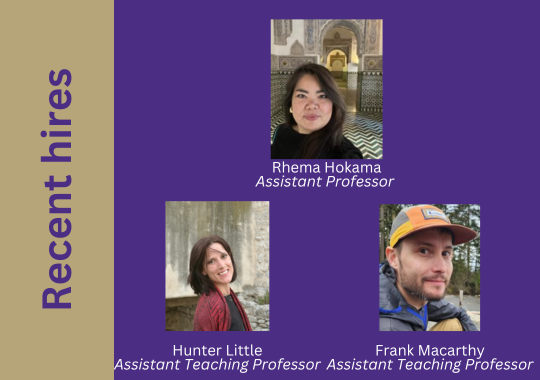
In 2025, the English Department welcomed three remarkable new faculty members: Rhema Hokama (Assistant Professor of English Literature), Hunter Little (Assistant Teaching Professor in the Program for Writing Across Campus and Program for Writing and Rhetoric), and Frank Macarthy (also Assistant Teaching Professor in PWAC and PWR). For this article, English's newest colleagues responded to interview questions about their work. As you’ll see from their responses, they bring scholarship and teaching that promises to enrich UW’s intellectual community and shape the future of literary and writing studies at the university and beyond.
Rhema Hokama: Globalism and the Renaissance Reimagined
After nearly a decade teaching in Singapore, Rhema Hokama returned to the U.S. and to her “spiritual home in literary studies” to join UW’s English Department this past January 2025. Hokama’s international experience profoundly informs her research and teaching. In Singapore, Hokama taught Plato, Confucius, Shakespeare, and Milton to students from more than forty countries, an experience which sparked her current book project on globalism in the Renaissance world. This ambitious work explores how European ideas about toleration and cultural diversity were shaped by early modern encounters with non-European cultures and religions, spanning geographies from the Americas to Asia.
Hokama teaches from her perspective as “a fellow student of literature and life.” In large seminar classrooms, she strives to make learning feel intimate and meaningful, promising to memorize every student’s name by the third week and holding herself to that promise. Her approach draws on Montaigne’s timeless insight about the most difficult task of teaching, which Hokama summarizes thusly: “to know how to modulate the learning process for every single student, and to understand each learner as whole human being with unique capabilities and aspirations.” To do this, Hokama focuses on getting to know her students’ writing intimately, as well as connecting to the ways in which literature has shaped their lives and their senses of identity.
Beyond the English classroom, Hokama is building bridges across disciplines. She recently submitted a proposal to the Simpson Center for the Humanities for an interdisciplinary research group focused on globalism in antiquity and the early modern world, aiming to create a collaborative community for scholars exploring transnational exchange.
Hunter Little: Writing Transfer and Disability Studies
Hunter Little, who joined the English Department this Autumn 2025, is a scholar with expertise in writing studies, transfer theory, and disability studies. As an instructor, Little is passionate about helping students transfer their writing knowledge across disciplinary and professional contexts, making genre and rhetorical theory central to her pedagogy. Her pedagogical research asks critical questions such as: How do students adapt writing knowledge for new situations? And how can we make these processes more inclusive, especially for students with disabilities?
Little’s work on disability literacy is particularly exciting. By integrating universal design for learning (UDL) principles into her teaching, she seeks to create learning environments in which students of all abilities can thrive through proactive, inclusive practices. Meanwhile, her research aims to expand conversations about accessibility across the university, ensuring that writing becomes a tool for equity rather than a barrier. In particular, as she settles into her teaching and mentorship work in the Program for Writing Across Campus, Little says that she is interested in studying “what types of writing are assigned across the disciplines and what instructors see the role of writing in their classes to be.”
In her own classroom, Little emphasizes collaboration and community, encouraging students to see every activity as a shared endeavor. This even includes “their processes of secondary research,” Little says. A quirky but effective element of Little’s pedagogy is tracking the first student to use another’s name in discussion; much like Hokama, Little puts particular value on student and faculty gestures of recognition, building a sense of belonging that transforms the learning experience.
Frank Macarthy: Technofeminism and the Future of Composition
Frank Macarthy also joined the department in Autumn 2025, and his research agenda feels urgently relevant: exploring how AI is reshaping composition and translanguaging processes. In his ENGL 282 Intermediate Multimodal Composition course, Macarthy is collecting student perspectives on AI’s role in writing. This project will inform a co-authored article for Applied Linguistics Review and other future work. Rather than framing AI as simply “good” or “bad,” Macarthy seeks a nuanced, student-centered understanding that eschews technological determinism.
It follows, therefore, that Macarthy’s teaching philosophy is grounded in flexibility and responsiveness. While major projects in his courses are planned in advance, he designs weekly lessons based on students’ evolving needs and interests. This adaptive approach means that two sections of the same course might look radically different by week three, a testament to his commitment to meeting students where they are. Similar to Little’s, Macarthy’s classroom is grounded in community-building. He engages students through their passions—majors, hobbies, hopes, dreams, and fears—and even curates a playlist of their favorite music for daily free writes. Music, he says, is a “phenomenal connecting force,” and his office (complete with Lego displays) reflects the same playful, creative energy.
Influenced by Judy Wacjman’s book Technofeminism and mentored by Illinois State University’s Dr. Joyce Walker, Macarthy brings a critical lens to technology’s role in shaping identity and pedagogy. His work promises to enrich departmental conversations about AI and other emerging technologies, community ethics, and the future of writing instruction.