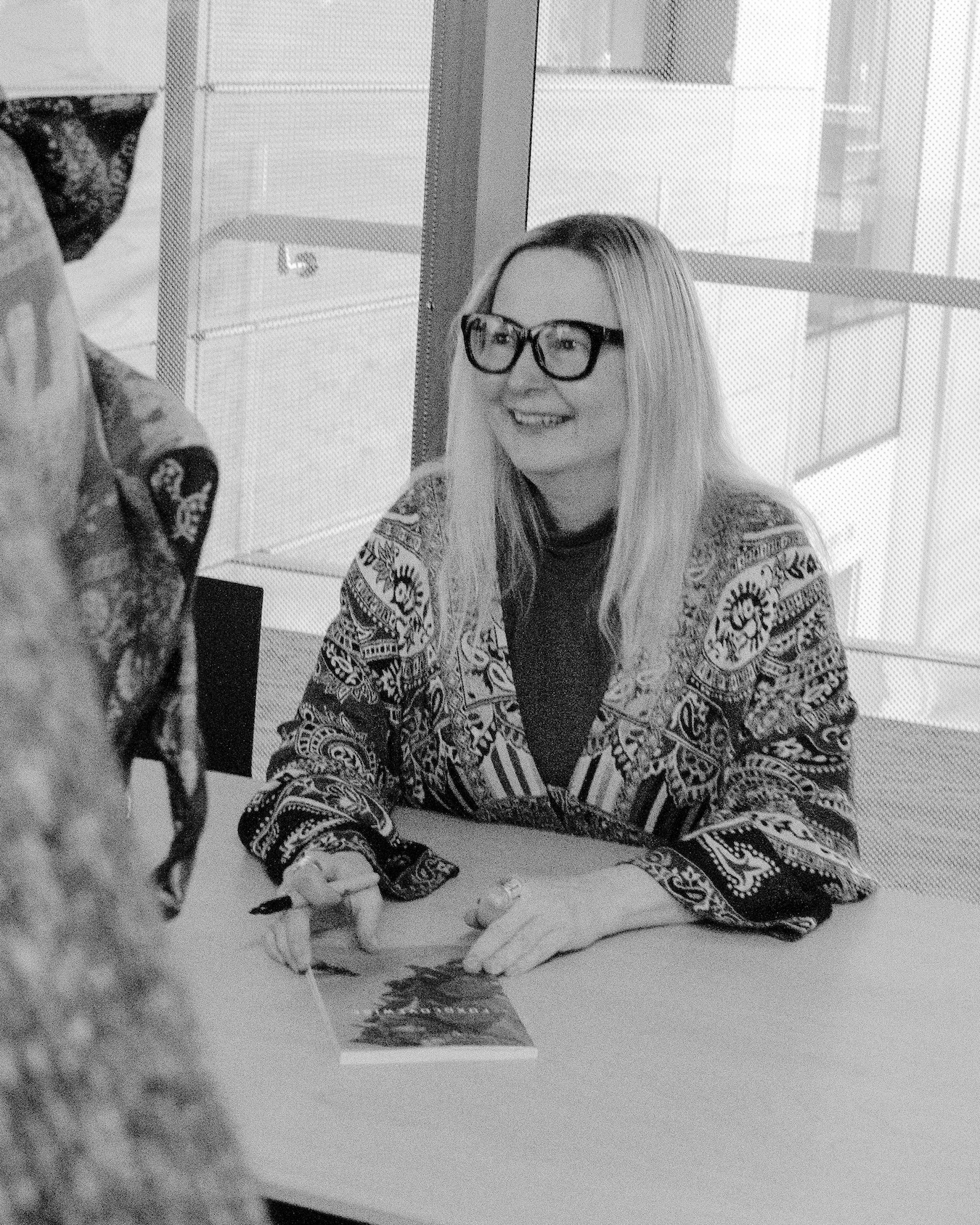
On Wednesday April 8, 2026, the UW English Department featured a dazzling lecture on poetry by the nationally-acclaimed poet and critic Ange Mlinko, who came to Seattle for our ninth Lee Scheingold Lecture in Poetry and Poetics. Andrew Feld, director of our Creative Writing program, began the event with a charming and humorous introduction to Mlinko’s poetry and criticism, both of which are among the best that the United States is producing today.
Mlinko’s lecture, “When Poets Say Nothing,” addressed the use of a negative mode in poetry, called apophasis or the apophatic. Her title itself is a clever pun that operates on several levels. Poets have always been accused of saying nothing much, of course. William Butler Yeats describes this accusation as a professional hazard; to be a poet is to “[b]e thought an idler by the noisy set / Of bankers, schoolmasters, and clergymen / The martyrs call the world.” On a different level, though, it is equally true that poets themselves invoke the negative to create distinct artistic and intellectual effects from those of positive language. As Mlinko noted, the apophatic is historically connected to theology, with figures from the ancient world such as Saint Augustine of Hippo urging that correct human understanding of God must always be tempered by humility. Humans cannot understand the divine, writes Augustine; if you think you understand something, you can be sure it is not God. Poets say nothing when nothing is precisely the thing that needs to be said.
Mlinko then launched into a tour de force presentation of a large set of modern poets, from the libertine Earl of Rochester’s comic celebration of nothings to Gerard Manley Hopkins’s heart-rending use of the negative to describe his struggles with debilitating personal depression. Hopkins's poetry from this period served as a great example for Mlinko. The best that he could manage during that dark time in his life was to hope for a hope that he could not feel:
Not, I’ll not, carrion comfort, Despair, not feast on thee;
Not untwist—slack they may be—these last strands of man
In me or, most weary, cry I can no more. I can;
Can something, hope, wish day come, not choose not to be.
In a desperate reenactment of Hamlet’s “To be, or not to be” soliloquy, Hopkins finds that he can refuse suicide (“not choose not to be”) even when he cannot positively choose to live (“to be”). This effort saved the life of one of the 19th century’s best poets, after all. Examples of the apophatic from other poets followed thick and fast, among them Emily Dickinson (“I'm Nobody! Who are you?”), Wallace Stevens (“Nothing that is not there and the nothing that is”), and Mary Jo Salter (“Nothing by design. / Complaint for Absolute Divorce, / let me salute you, sole recourse!”). Mlinko emphasized the agency that comes from certain kinds of refusal, the space made by certain kinds of withdrawal. Good poets are like good architects, she said: they are conscious of the hard matter with which they build, but equally conscious of the spaces that their art creates and engenders.
Mlinko’s talk was followed by a staged conversation with Anne Duncan (MFA / PhD candidate) and Piotr Florcyzk (Slavic Languages). Duncan inquired thoughtfully about apophasis as a humbler alternative to declarative punditry or what Mlinko had once called “unearned oracular pronouncements.” Florcyzk inquired about the rigors of directing an MFA program in our age of dizzying AI technology. Mlinko was a genial and thoughtful interlocutor. Honestly, Mlinko remarked, at a time when AI is eating all of the computer programming jobs, doesn’t it actually make far more existential sense to get a degree in poetry?
We offer special thanks to Lee Scheingold, to Ange Mlinko, to Anne Duncan and Piotr Florcyzk, to English Department Chair Habiba Ibrahim, to Karla Tofte and Karen Wennerstrom for helping to coordinate the event, and to our videographer Shahruz Haemi. And of course, thanks to all who attended!
You can watch Mlinko's lecture on the embedded player below: