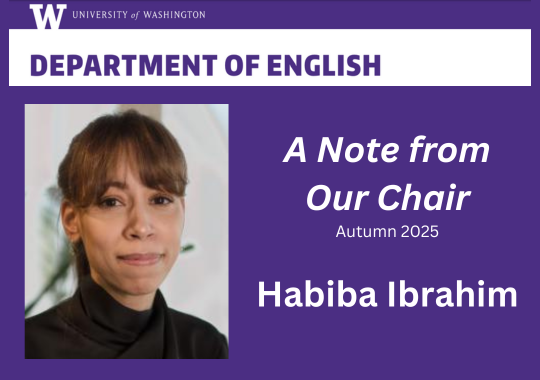
Greetings from Padelford, during a time of year in Seattle that is sometimes referred to as the “Big Dark.” From the middle of October into spring, the days are short and gray. Nowadays, on work days, I can arrive on campus not long after the sunrise and leave well after sunset. I mention the seemingly endless stretch of Seattle gloom to remind us that there are ways to manage in times of darkness.
Key among them is “cultivating connection,” to borrow Professor Cristina Sánchez-Martín’s phrase. In Autumn Quarter, Professor Sánchez-Martín led a session called “Navigating unequal language spaces and cultivating connections through critical language pedagogy.” The event was part of the UW Language Pedagogy Circle, a faculty-led initiative organized by the Language Learning Center. The session opened consideration of what “it means to teach language critically, while cultivating sustainable practices that contribute to building resilient and joyful networks for linguistically-minoritized communities.” A critical language pedagogy that recognizes multiple possibilities for living in language envisions space for language practices, teaching, and learning capaciously. There is a dynamism to recognizing and building life- affirming networks for connection, against the stasis and closure of pedagogical convention.
There is also a dynamism to what Professor Chadwick Allen describes in his study of Indigenous earthworks. In his forthcoming book, Transit: Serpent Mound Crossing Space, Time, Discourse, Professor Allen considers the existence and movement of an ancient Indigenous earthen effigy know as “Serpent Mound,” and the possibility of an earthen mound that was built on the eastern part of the North American continent moving to the Pacific Northwest. To arrive at such an understanding of an Indigenous earthen structure’s ability to move, rather than remain static, Professor Allen’s deep engagement with the context of the earth mound matters. Meaning moves, depending on the context.
Critical language teaching and the study of Indigenous earthen mounds are two vital examples of how English department faculty engage in pedagogical, communicative, and interpretive practices. By broadening the contextual frame for considering communication across space and time, they keep us keyed to who we are in relation to each other and the world. In terms of other faculty who take expansive approaches to the study of language and literary forms, including theater, Professor Catherine Cole was awarded the 2025 Distinguished Scholar Award for Outstanding Achievement in Scholarship in the Field of Theatre Studies from the American Society for Theatre Research. In terms of the expansion of departmental programs, Technical and Professional Communication (TPC) has been established as a standalone program, thanks to the efforts of the program’s faculty: Professors Josephine Walwema (director), Chris Holstrom, Linford Lamptey, and Calvin Pollak.
All good things may come to an end, but there is a seasonal end to darkness, too. Until then, we can cultivate connections, and envision what comes next. As Gwendolyn Brooks famously puts it in the poem “truth” (1949), “And if sun comes/ How shall we greet him?”